How to Recover a Domain from a Previous Developer or Agency in Nepal

Have you lost access to your business domain because your previous web developer or agency registered it using their email account? Recovering a domain from a previous developer in Nepal is possible in many cases, but the process depends on the domain extension, registrar, registered owner, and documents you can provide.

This problem is more common than many business owners expect. A developer may have registered the domain for you, managed the DNS, or kept the domain inside their own account. When the relationship ends, you may discover that you do not have the login details or control over the domain.

The good news is that losing access to the developer does not automatically mean losing your domain.

This guide explains what you should do if your domain is controlled by a previous developer or agency in Nepal, including .com, .net, .org, .com.np, and other domains.

What Does It Mean to Recover a Domain?

Domain recovery means regaining administrative control of a domain name that is currently controlled by another person, developer, agency, or account.

For example, suppose your company owns yourcompany.com, but your previous developer registered it using their personal email address.

You may still own the business and brand, but you cannot:

  • Log in to the domain account
  • Change DNS records
  • Renew the domain
  • Change nameservers
  • Move the domain to another provider
  • Manage domain-related email services
  • Transfer the domain to another registrar

In this situation, the first step is to determine who is actually listed as the domain registrant.

Why Do Businesses in Nepal Lose Control of Their Domains?

There are several common reasons.

1. The Developer Registered the Domain

Some businesses ask their web developer to purchase the domain as part of a website project.

The developer may then register it using:

  • Their company email
  • Their personal email
  • Their registrar account
  • Their own billing account

This can become a problem when the website project ends.

2. The Domain Was Registered Under the Agency’s Account

A developer may manage dozens or hundreds of domains from one account.

If your domain is inside their account, you may not have direct access even though the domain is being used for your business.

3. The Business Owner Does Not Know the Registrar

You may know your domain name but not know where it was registered.

For example, the domain could be registered through a local provider, an international registrar, or another reseller.

4. The Developer Has Stopped Responding

Sometimes the agency closes, changes staff, stops providing services, or simply stops responding to the client.

This is especially risky if the domain is approaching its renewal date.

5. The Domain and Hosting Were Treated as One Service

Some businesses assume that the domain and website hosting are the same thing.

They are not.

You can move your hosting to another company while keeping the domain with the existing registrar. You can also move the domain without moving the website.

Understanding this difference makes recovery much easier.

First, Check Who Controls Your Domain

Before contacting anyone, collect information about your domain.

Start with a domain lookup.

For generic domains such as .com, .net, and .org, you can use the ICANN lookup system to identify the registrar. ICANN explains that domain registrants have rights related to managing, transferring, renewing, and restoring their domain registrations.

For Nepal’s .np domains, the official .np registry provides a WHOIS lookup service.

Check These Details

Record as much information as possible:

Information Why It Matters
Domain name Identifies the domain you need to recover
Registrar Shows which company manages the domain
Registrant name Helps establish who the domain belongs to
Registrant organization Useful for company-owned domains
Registrant email Important for verification and recovery
Expiry/renewal status Helps prevent accidental loss
Nameservers Shows where DNS is currently managed
Current developer May still have account access
Registration documents Can help prove ownership

Do not change DNS records yet unless you understand what they do.

Determine Whether the Domain Is Actually Registered to Your Business

This is one of the most important steps.

There is a difference between:

“My business paid for the domain”

and

“My business is the registered domain holder.”

Ideally, your business should appear as the registrant or registered organization.

For example:

Good setup:

Registrant: ABC Trading Pvt. Ltd. Email: [email protected]

Risky setup:

Registrant: John Doe Email: [email protected]

The second setup does not automatically settle the legal ownership question, but it can make recovery much harder.

For .np domains, the official registry states that the administrative name and email should belong to the actual owner, not the technical contact.

This is why businesses should register important digital assets using company-controlled information.

If You Have a .com.np Domain

The recovery process for .com.np is different from the process for .com domains.

Nepal’s official .np registry, operated by Mercantile Communication, provides a specific account transfer process for .np domains.

.com.np domain whois

How to Recover a .com.np Domain

If the previous developer controls your .com.np domain, you can request an account transfer.

For a personal domain, the official process requires:

  1. A formal transfer request letter
  2. The current account information
  3. The destination account information
  4. A copy of an accepted identification document

For an organizational domain, you generally need:

  1. A formal request on company letterhead
  2. The current account information
  3. The destination account information
  4. A company, brand, or trademark registration document

The recipient must already have an account registered at register.com.np. The official instructions also direct users to contact the .np domain administration team at Mercantile.

What If You Cannot Contact the Previous Developer?

This is where your documents become important.

If the domain belongs to your company and you can provide company registration or other supporting documents, contact the .np Domain Administration team and explain the situation.

The official .np registry says domain registration information should reflect the actual owner and provides a process for account transfers.

You should clearly explain:

  • Your company name
  • The domain name
  • The previous developer or agency
  • How the domain was registered
  • Why you no longer have access
  • What documents you can provide
  • The account where you want the domain transferred

Keep copies of all correspondence.

If You Have a .com, .net, or .org Domain

The process is different for domains such as .com, .net, and .org.

These domains are generally managed through a registrar.

Your first goal is to identify the registrar and then contact it.

ICANN states that the registrant has the right to transfer a domain between registrars, subject to applicable transfer rules and restrictions.

Step 1: Find the Registrar

Use ICANN’s lookup service:

Find the registrar listed for your domain.

Step 2: Contact the Registrar

Tell the registrar that:

You are the business owner or authorized representative and your former web developer controls the domain account.

Ask what documentation they require to verify your identity or ownership.

Do not simply ask them to “give you the domain.” Explain the complete situation and provide supporting evidence.

Step 3: Prepare Ownership Evidence

Useful documents may include:

  • Company registration certificate
  • PAN or VAT registration
  • Trademark registration
  • Business website information
  • Original domain invoice
  • Payment receipt
  • Contract with the developer
  • Email correspondence
  • Domain renewal invoices
  • Company letterhead
  • Identification of an authorized company representative

The exact requirements depend on the registrar and circumstances.

Step 4: Request Account or Registrant Recovery

If you can prove that you are the registered domain holder, the registrar may provide a recovery process.

If the domain is registered to your business but the developer controls the login, this may be easier than a dispute over ownership.

What If the Developer Is Listed as the Registrant?

This is more complicated.

Suppose your company paid for the domain, but the developer registered it under:

Developer Name Developer Email Developer Company

In this case, you should not assume that a registrar will automatically transfer the domain to you.

The registrar may need evidence showing your relationship with the domain and the developer.

Your evidence could include:

  • Website development agreement
  • Domain purchase invoice
  • Payment records
  • Emails discussing the domain
  • Messages showing the developer registered it for your company
  • Company registration documents
  • Branding or trademark records
  • Previous renewal payments
  • Written confirmation from the developer

ICANN explains that changing registrant information is handled by the registrar and that disputes may involve additional procedures.

If the parties disagree about ownership, you may need professional legal advice.

Send a Formal Request to the Previous Developer

Before starting a formal dispute, send the previous developer a clear written request.

Do not rely only on phone calls or informal messages.

Ask for:

  1. Domain registrar login access, or
  2. Transfer of the domain to your account, or
  3. An authorization code if a registrar transfer is required, and
  4. DNS management access

For generic domains, an Auth-Code may be required to transfer the domain to another registrar. ICANN describes the Auth-Code as a code used to help authorize domain transfers.

Keep the communication professional.

Avoid threatening language unless you are already working through a legal process.

What If the Developer Refuses to Give You the Domain?

If the developer refuses to cooperate, the next step depends on how the domain is registered.

Situation 1: Your Business Is the Registrant

This is generally a stronger position.

Contact the registrar and explain that you have lost access to the account.

Provide the requested verification documents.

Situation 2: The Developer Is the Registrant

You may need to establish your claim using contracts, invoices, payment records, company documents, and communications.

If the dispute cannot be resolved between the parties, professional legal advice may be appropriate.

Situation 3: The Domain Was Transferred Without Permission

Treat this as a potential unauthorized transfer.

ICANN advises domain holders to contact the registrar immediately if a domain was transferred or registrant information changed without authorization. In certain cases, the registrar may be able to review or reverse an unauthorized transfer.

Do not wait for months before reporting a suspected unauthorized transfer.

Do Not Confuse Domain Recovery With Website Recovery

This is a common mistake.

Your website has several separate components.

Asset What It Controls
Domain Your website address
DNS Where domain services point
Hosting Where your website files live
Website files Your actual website
Database Website data
Email hosting Business email
CMS WordPress or another website system
SSL certificate Secure HTTPS connection

Recovering the domain does not automatically recover your website files.

Likewise, getting website files does not automatically give you control of the domain.

You should recover all important assets separately.

Check Your DNS Before Making Changes

Once you regain domain access, do not immediately delete existing DNS records.

Your DNS may control:

  • Website hosting
  • Business email
  • Microsoft 365
  • Google Workspace
  • Email verification
  • Payment services
  • Marketing tools
  • Subdomains
  • SSL validation

Changing nameservers without checking the existing setup can cause your website or email to stop working.

For .np domains, the official registry explains that nameserver changes are made through the domain management system and that DNS propagation can take time after changes.

Take a DNS Backup

Before making major changes, record:

  • A records
  • AAAA records
  • CNAME records
  • MX records
  • TXT records
  • SPF records
  • DKIM records
  • DMARC records
  • Nameservers
  • Important subdomains

This gives you a reference if something breaks.

Check Your Business Email Before Moving the Domain

Be especially careful if your domain is used for email.

For example:

[email protected] [email protected] [email protected]

These addresses may depend on MX records and other DNS settings.

If you change the nameservers without copying the email records, email delivery may stop.

Before moving the domain, identify whether your business uses:

  • Microsoft 365
  • Google Workspace
  • cPanel email
  • Hosting-provider email
  • Another email platform

A domain recovery project should protect both the website and business communication.

Recover the Registrar Account, Not Just the Website

If the previous developer gives you only WordPress administrator access, your domain problem is not solved.

You should ideally have direct access to:

  • Domain registrar
  • Domain account
  • DNS management
  • Hosting account
  • Website CMS
  • Website files
  • Database
  • Business email
  • SSL management
  • Renewal and billing information

The developer can still remain a technical administrator if you choose, but your business should control the core accounts.

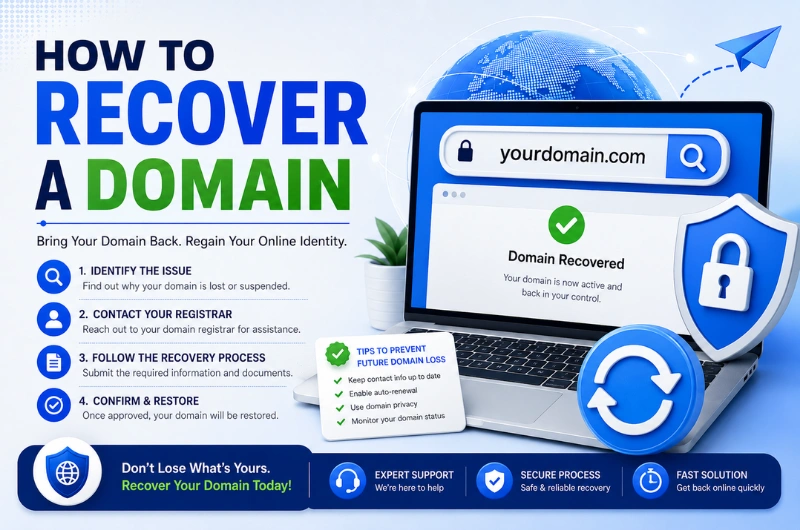
A Simple Domain Recovery Process for Nepal

Here is a practical process you can follow.

Step 1: Write Down the Domain

Start with the exact domain name.

Example:

yourcompany.com

or

yourcompany.com.np

Step 2: Check the Domain

Find:

  • Registrar
  • Registration status
  • Registrant information where available
  • Nameservers
  • Renewal status

Step 3: Collect Your Documents

Prepare your company registration, PAN/VAT documents, invoices, contracts, and payment records.

Step 4: Contact the Previous Developer

Request the domain account or domain transfer in writing.

Step 5: Contact the Registrar or .np Registry

If the developer does not cooperate, contact the organization managing the domain.

Step 6: Complete Verification

Submit the documents requested by the registrar or registry.

Step 7: Create Your Own Account

Use a company-controlled email address.

Avoid using the developer’s email address.

Step 8: Transfer the Domain

For applicable generic domains, follow the registrar transfer process. For .np domains, follow the official account transfer process.

Step 9: Secure the Account

Enable:

  • Strong password
  • Two-factor authentication where available
  • Recovery email
  • Recovery phone
  • Company billing information

Step 10: Review DNS

Make sure your website and email continue working.

How Long Does Domain Recovery Take?

There is no single recovery time.

It depends on:

  • Domain extension
  • Registrar
  • Whether you can access the registered email
  • Whether the previous developer cooperates
  • Ownership evidence
  • Whether there is a dispute
  • Whether the domain is expired
  • Whether the domain is locked

A simple account recovery may be relatively quick.

A disputed domain can take much longer.

For .np domains, Mercantile’s official process requires documentation and verification for account transfers.

Do not promise a specific recovery time until the registrar or registry has reviewed the case.

What If Your Domain Is About to Expire?

Treat this as urgent.

A domain that expires can create serious problems for your:

  • Website
  • Email
  • Online advertising
  • Search traffic
  • Customer communication
  • Brand reputation

Contact the registrar immediately and ask about the domain’s current status.

For generic domains, expired-domain rules can affect whether the domain can still be renewed or transferred. ICANN’s policies recognize expiration as one circumstance that can restrict certain domain changes.

Do not wait for the previous developer to respond if the domain is close to expiry.

What If the Developer’s Email Is Still Connected to the Domain?

This is another common problem.

Suppose the registrar account uses:

[email protected]

instead of:

[email protected]

You should ask the registrar what account-recovery options are available.

If you successfully recover the account, immediately replace the developer’s:

  • Email address
  • Phone number
  • Recovery information
  • Password
  • Two-factor authentication method

The same principle applies to .np domains. The official registry recommends keeping administrative contact information accurate and up to date.

Common Mistakes to Avoid

Mistake 1: Creating a New Domain

Do not register a different domain simply because you cannot access the old one.

Your existing domain may have years of:

  • Google rankings
  • Backlinks
  • Customer recognition
  • Email history
  • Brand value

Try to recover it first.

Mistake 2: Changing DNS Without a Backup

A wrong DNS change can take your website or email offline.

Document the existing configuration first.

Mistake 3: Assuming Hosting Access Means Domain Access

Having a cPanel login does not necessarily give you control over the domain.

Mistake 4: Using the Developer’s Email Forever

Your domain account should use a business-controlled email address.

Mistake 5: Ignoring Renewal Dates

Always know when your domain needs to be renewed.

Mistake 6: Relying Only on Phone Calls

Keep important requests and agreements in writing.

Email provides a useful record of what was requested and when.

Mistake 7: Sharing Passwords

Do not solve an access problem by sharing one master password with several people.

Use individual accounts and proper access controls whenever the provider supports them.

How Businesses in Nepal Can Prevent Domain Ownership Problems

The easiest domain recovery is the one you never need.

When registering a domain for your business, follow these practices.

Register the Domain in the Company’s Name

Use the legal business name where appropriate.

Use a Company-Controlled Email

For example:

[email protected]

or

[email protected]

Avoid using an employee’s personal Gmail account.

Keep Domain and Hosting Separate

Your business should know which company manages:

  • Domain
  • Hosting
  • DNS
  • Email

Keep Copies of Invoices

Save domain purchase and renewal receipts.

Maintain a Digital Asset Register

Create a simple document containing:

Asset Account Owner Provider Renewal
Domain Company Registrar Date
Hosting Company Hosting provider Date
Email Company Microsoft 365/Google Date
Website Company CMS/Hosting N/A
DNS Company Registrar N/A

Do not store passwords in a normal spreadsheet. Use a secure password manager.

Keep the Developer as a Technical Contact

A developer can manage technical tasks without being the owner of your most important digital assets.

Can a New Web Developer Help Recover Your Domain?

Yes, a new web developer can often help with the technical side of the process.

A professional web development company can help you:

  • Identify the registrar
  • Check DNS records
  • Review hosting
  • Identify email dependencies
  • Prepare technical information
  • Move hosting
  • Configure DNS after recovery
  • Secure your website
  • Transfer website files
  • Set up a new hosting environment

However, the legal or registration authority over a domain belongs to the domain registrar or registry and depends on the registration records and applicable policies.

A web developer cannot simply declare a domain theirs or yours.

For example, Webtech Nepal provides website design, hosting, domain registration, and website-related services, and can also work with websites originally built by another company.

If you need help assessing an existing website or moving it to a new technical setup, you can also contact the Webtech Nepal team in Kathmandu.

Domain Recovery Checklist for Businesses in Nepal

Use this checklist before starting the recovery process:

  • Confirm the exact domain name
  • Identify the domain extension
  • Find the current registrar or .np account
  • Check the registered owner
  • Check the domain status
  • Check the renewal/expiry status
  • Find the current nameservers
  • Identify the previous developer or agency
  • Collect company registration documents
  • Collect domain invoices and payment records
  • Collect the website development agreement
  • Save relevant emails and messages
  • Request access from the previous developer
  • Contact the registrar if necessary
  • Follow the official .np transfer process for .np domains
  • Create a company-controlled domain account
  • Update administrative contact details
  • Review DNS records
  • Check website and email after recovery
  • Enable stronger account security

Frequently Asked Questions

Can I recover my domain if my previous web developer has the login?

Yes, in many cases. Start by identifying the registrar and checking who is listed as the domain holder. If the domain belongs to your business, contact the registrar with supporting documents and request account recovery.

Can I recover a .com.np domain from a previous developer?

Yes. Nepal’s official .np registry has an account transfer process. Organizational domains require a formal transfer request and company, brand, or trademark documentation, while personal domains require appropriate identity documentation.

What documents can prove that a domain belongs to my company?

Useful evidence can include company registration documents, domain invoices, payment receipts, contracts, emails, trademark documents, and correspondence showing that the developer registered the domain for your business.

What if the domain is registered under the developer’s name?

Recovery can be more complicated. You may need to provide evidence of your agreement and relationship with the developer. If the parties disagree about ownership, consider obtaining legal advice.

Can my new web developer transfer the domain?

A new developer can help with the technical process, but the registrar or registry controls the formal domain transfer process. For generic domains, the registered domain holder must authorize the transfer under applicable rules.

Can I move the website without moving the domain?

Yes. You can move your website hosting while keeping the domain at the existing registrar. This can be useful when you cannot immediately transfer the domain.

What happens if my developer refuses to return my domain?

First, document your ownership claim and contact the registrar or registry. If the domain was transferred or changed without authorization, report the matter to the registrar promptly. ICANN notes that unauthorized transfer cases should be raised with the registrar immediately.

Should my developer own my business domain?

Usually, no. Your business should control its own domain account, registrant information, recovery email, and renewal details. Your developer can have technical access without being the domain owner.

Can I recover a domain after it expires?

It depends on the domain extension, registrar, and current domain status. Contact the registrar immediately because expiration can limit renewal or transfer options.

How can I prevent this problem in the future?

Register the domain using your company’s information, use a company-controlled email address, keep renewal records, maintain access to the registrar account, and make sure your business—not your developer—controls the primary domain account.

Conclusion

Recovering a domain from a previous developer or agency in Nepal is often possible, but you should act quickly and start with the domain’s registration information.

First, identify the registrar or .np account. Then check who is listed as the domain holder, collect your company documents and payment records, and contact the previous developer or the relevant registrar.

If you own a .com.np domain, Nepal’s official .np registry provides a specific account transfer process. For .com, .net, .org, and similar domains, the process normally involves the registrar and may require account recovery, authorization, or a formal transfer.

Most importantly, don’t let a web developer become the permanent owner of your company’s digital assets.

Your business should control the domain, hosting, DNS, website, email, and recovery accounts. Developers and agencies should receive the access they need to do their work without taking ownership away from you.

If your website was built by another company and you need help reviewing the current setup, recovering technical access, moving hosting, or managing your website after the transition, Webtech Nepal can help you assess the existing website and plan the next step.

Register a Free .com.np Domain in Nepal: Complete Guide

If you’re starting a business, creating a personal website, or launching a new brand in Nepal, one of the first things you’ll need is a domain name. The good news is that you can register a .com.np domain for free if you meet the eligibility requirements.

A .np domain is Nepal’s official country code top-level domain (ccTLD). Unlike many other domain extensions, eligible individuals and organizations can register it at no cost. The registration is handled on a first-come, first-served basis by Mercantile Communications Pvt. Ltd., the official registry for .np domains.

In this guide, you’ll learn what a .np domain is, who can register one, the documents you’ll need, and the complete registration process.

What Is a .np Domain?

A .np domain is the official internet domain extension for Nepal. It helps identify websites that belong to individuals, businesses, organizations, and institutions connected to Nepal.

The most popular extension is .com.np, but several other categories are available depending on the type of organization.

Unlike commercial domain extensions such as .com, eligible users do not pay a registration fee for a .np domain.

Quick Answer: A .np domain is Nepal’s official domain extension that eligible Nepalese individuals and organizations can register free of charge.

Why Choose a .com.np Domain?

A .com.np domain offers several benefits for businesses and individuals in Nepal.

It’s Free

You don’t have to pay any registration fee if your application meets the registry requirements.

Builds Local Trust

Visitors immediately recognize your website as being based in Nepal, which helps build credibility with local customers.

Better for Local Branding

A .com.np domain clearly shows your connection to Nepal, making it ideal for local businesses, startups, freelancers, and professionals.

Great for SEO

Although content quality remains the most important ranking factor, using a local domain can help search engines understand your target audience in Nepal.

Who Can Register a .np Domain?

Only individuals and organizations with a legitimate connection to Nepal can register a .np domain.

You may apply if you are:

  • A Nepalese citizen
  • A registered company in Nepal
  • A nonprofit organization
  • A government agency
  • An educational institution
  • A foreign organization officially registered in Nepal
  • A trademark owner with rights in Nepal

Applications must follow the registry’s naming policy. Generally, the requested domain should match your:

  • Personal name
  • Business name
  • Organization name
  • Registered brand
  • Product or service name

Since registrations are approved on a first-come, first-served basis, availability is not guaranteed.

Can You Buy or Sell a .np Domain?

No. The .np domain cannot legally be purchased for resale or transferred like many commercial domain names.

The registry assigns domains based on eligibility and supporting documents rather than auctions or marketplace sales.

Documents Required for .np Domain Registration

The documents depend on whether you’re registering as an individual or an organization.

For Individuals

You must provide one of the following:

  • Nepal Citizenship Certificate
  • Passport
  • Driving License
  • Voter ID Card
  • Non-Resident Nepali (NRN) ID Card
  • Nepal Resident Visa (for eligible foreign nationals)

Important: Your requested domain should closely match the name shown on your identification document.

For Companies and Organizations

Depending on your organization type, you may need:

Organization Type Required Documents
Registered company, partnership, or organization Company Registration Certificate
Foreign company registered in Nepal Branch Registration Certificate or Social Welfare Council Affiliation Certificate
Permanent Establishment or Joint Venture PAN Registration Certificate
Trademark holder Trademark Registration Certificate or official trademark filing receipt issued in Nepal

If you apply using a trademark application receipt, the official trademark registration certificate must usually be submitted within the required time period specified by the registry.

How to Register a Free .com.np Domain

Follow these simple steps.

Step 1: Search Your Domain Name

.com.np domain available status

Visit the official .np domain registration portal and search for your preferred domain name.

If the domain is available, continue with the registration.

If it isn’t available, choose another name that matches your identity or business.

Step 2: Create an Account

create account

Register a new account using your email address.

You’ll need to:

  • Enter your email
  • Create a password
  • Verify your email address

Step 3: Complete Your Profile

After logging in:

  • Fill in your personal or business information.
  • Upload the required supporting documents.
  • Ensure your documents are clear and readable.

Common supported file formats include:

  • JPG
  • JPEG
  • PNG
  • GIF

Step 4: Submit Your Application

search domainpng

Review all information carefully before submitting.

Incorrect names, missing documents, or mismatched information may delay approval.

Step 5: Wait for Verification

The registry reviews every application manually.

If everything matches the requirements, your domain will be approved and activated.

Approval time can vary depending on application volume.

Available .np Domain Extensions

Different .np domain categories are available for different purposes.

Domain Extensions Entry area Notes
.com.np commercial This is an open ccTLD, meaning any person or entity may register a domain. Although it was originally intended for for-profit business entities, it has become the primary ccTLD for domain registrations and is now used by a wide range of organizations and individuals, including nonprofits, educational institutions, and private individuals. To prevent domain squatting, registrations may be challenged if the registrant cannot demonstrate a legitimate connection or interest that justifies reserving the domain name.
.coop.np cooperatives The .coop.np ccTLD is restricted to registered cooperatives.
.edu.np educational The .edu.np ccTLD is restricted to eligible educational institutions, including but not limited to primary schools, secondary schools, colleges, and universities.
.gov.np governmental The .gov.np ccTLD is restricted to government entities and agencies of Nepal.
.info.np information This is an open ccTLD, meaning any person or entity may register a domain.
.mil.np Nepal military The .mil.np ccTLD is restricted to use by the Nepal Army and other authorized military entities of Nepal.
.name.np individuals, by name This is an open ccTLD, meaning any person or entity may register a domain. However, registrations may be challenged if they do not comply with the domain’s charter, which is intended for individuals or the owners of fictional characters.
.net.np network Intended for domains representing distributed computer networks or umbrella sites that serve as portals to a collection of related websites.
.org.np organization Intended primarily for non-profit organizations and continues to be used predominantly by such organizations.

Always choose the extension that best represents your organization or purpose.

Common Reasons for Application Rejection

Applications may be rejected for several reasons, including:

  • The requested domain doesn’t match your legal name.
  • Required documents are missing.
  • Uploaded documents are unclear.
  • Someone has already registered the domain.
  • The requested name doesn’t meet registry guidelines.

Checking everything before submission can help avoid delays.

Frequently Asked Questions

Is a .com.np domain really free?

Yes. Eligible Nepalese individuals and organizations can register a .com.np domain without paying a registration fee.

Can anyone register a .np domain?

No. You must have a legitimate connection to Nepal and provide valid supporting documents.

Can I register multiple .np domains?

Yes, provided each requested domain meets the registry’s naming rules and eligibility requirements.

How long does approval take?

Approval times vary depending on document verification and application volume.

Can I transfer or sell my .np domain?

No. .np domains are assigned based on eligibility and cannot be registered for resale.

Can I register a domain that doesn’t match my name or business?

No. The requested domain must have a clear and justifiable connection to your personal name, business name, organization, trademark, product, or service, depending on the registration category.

What documents do I need to register a .com.np domain?

The required documents depend on whether you are registering as an individual or an organization. Generally, you’ll need a valid identity document for personal registrations or official registration documents for businesses and organizations.

Can foreigners register a .np domain?

Foreign individuals cannot register a .np domain unless they have an eligible legal presence in Nepal or otherwise meet the registry’s requirements.

Do I need a cover letter for .NP domain registration?

Yes. A cover letter is one of the required documents for most personal and organization .NP domain registration applications. You can use our free NP Domain Cover Letter Generator to create a professionally formatted cover letter and download a ready-to-submit PDF in minutes.

Can I change the nameservers after my domain is approved?

Yes. You can update your domain’s nameservers through the registry portal after your domain has been registered.

Do I need web hosting before registering a .np domain?

No. You can register your domain first and connect it to a web hosting service provider later by updating your DNS settings.

Can I use my .np domain for email?

Yes. Once your domain is configured with a hosting or email service provider, you can create custom email addresses such as [email protected].

What happens if my registration is rejected?

If your application is rejected, you can review the reason, correct any issues, and submit a new application with the required information or documents.

Can I update my contact information later?

Yes. Administrative and technical contact details can be updated through the registry when necessary.

Is there a limit on the length of a .np domain name?

Yes. Domain names must comply with the registry’s naming rules and DNS standards, including length and character restrictions.

Can I register a trademarked or well-known brand name?

No. You may only register a domain if you have a legitimate right or interest in the requested name. Registrations that infringe on trademarks or violate registry policies may be rejected or revoked.

Need Help Registering Your .com.np Domain?

Registering a .com.np domain is simple when you have the correct documents and choose an eligible domain name. Once your domain is approved, you can start building your online presence with a professional website.

If you’d rather avoid the paperwork and verification process, Webtech Nepal can help you prepare the required documents, guide you through the registration process, and set up your website after your domain is approved.

10 Best Domain Registration Companies in Nepal

Choosing the right domain registration company in Nepal is crucial in establishing a strong online presence for your business or personal brand in Nepal. A domain name is more than just a web address; your digital identity impacts your SEO rankings, brand credibility, and customer trust. With numerous domain registrars operating in Nepal, finding a reliable, affordable, and feature-rich provider can be overwhelming.

To simplify your decision, we’ve compiled a list of Nepal’s 10 best domain registration companies based on pricing, features, customer support, and ease of use, ensuring you find the perfect fit for your needs.

Why Choosing the Right Domain Registrar Matters

Before diving into the list, let’s understand why selecting a reputable domain registrar is essential:

SEO Benefits: A relevant and memorable domain name can improve your search engine rankings.
Brand Identity: A domain name that aligns with your business creates a professional and trustworthy image.
Security: Top registrars offer features like domain theft protection and WHOIS privacy to safeguard your information.
Ease of Management: A user-friendly control panel and reliable support make domain management hassle-free.

With these factors in mind, Nepal’s top 10 domain registration companies are here.

1. Webtech Nepal

Webtech Nepal is a trusted domain registration and web hosting company in Nepal. They offer TLDs like .com, .net, and .org, with free add-ons such as email accounts, DNS management, and domain theft protection. They also assist with free .np domain registration and offer prompt support to help you quickly access your website. They accept Nepali payment gateway support (eSewa, Khalti), which adds convenience.

Key Features: Free email accounts, bulk tools, and 24/7 support.
Pricing: Starts at NPR 1,199/year for .com domains.
Why Choose Webtech Nepal?: Their focus on affordability and local payment options makes them accessible to Nepali users.

2. Nest Nepal

Nest Nepal is a leading domain registrar in Nepal, known for its affordability and comprehensive services. They offer a wide range of top-level domains (TLDs) like .com, .net, .xyz, and .com.np, as well as free privacy protection and DNS management. Their custom portal simplifies domain management, making it ideal for beginners and businesses.

Key Features: Free ID protection, EPP code, DNS management, and affordable pricing.
Pricing: Competitive rates start at NPR 1,199 and range from NPR 3,499 annually.
Why Choose Nest Nepal?: Excellent customer support and a user-friendly interface make it Nepal’s top choice for domain registration.

3. Prabhu Host

Prabhu Host is one of Nepal’s most affordable domain registration companies. They provide over 1,000 TLDs, including .com, .org, .np, and .in, with free features like DNS management, domain forwarding, and theft protection. Their packages often include a free domain with hosting plans, adding extra value.

Key Features: Free add-ons, privacy protection, and 24/7 support via chat, phone, and tickets.
Pricing: Starts at NPR 1,199/year for .com domains.
Why Choose Prabhu Host?: Transparent pricing and robust security features make it a trusted option for Nepali businesses.

4. Himalayan Host

Established in 2007, Himalayan Host is a reliable and long-standing player in Nepal’s domain registration market. They offer TLDs like .com, .net, .org, and .info, with free features such as ID protection, DNS management, and two mail IDs. Their 24/7 customer support ensures a seamless experience.

Key Features: Free ID protection, a control panel, and flexible payment options (eSewa, PayPal).
Pricing: Starts at NPR 2,025/year for .com domains.
Why Choose Himalayan Host?: Their experience and customer-centric approach make them a go-to choice for businesses.

5. Gurkha.Host

Gurkha. Host offers a wide variety of TLDs, including .com, .net, .biz, and .info, along with professional and country-level domains. Their complete control panel allows easy domain management and provides free email accounts, DNS management, and domain theft protection.

Key Features: Free email forwards, domain forwarding, and an intuitive control panel.
Pricing: Starts at NPR 2,062/year for .com domains.
Why Choose Gurkha.Host?: A robust feature set and competitive pricing make it ideal for startups and small businesses.

6. i3 Web Solution

Based in Thamel, Kathmandu, i3 Web Solution is a top IT company offering domain registration for .com, .net, .org, and .edu domains. They provide free consultancy to help you choose the best domain name and offer fast registration with a user-friendly control panel.

Key Features: Free .np domain registration support, DNS management, and reseller accounts.
Pricing: Starts at NPR 2,200/year for .com domains.
Why Choose i3 Web Solution?: Their expert guidance and affordable services cater to both individuals and businesses.

7. Weblink Nepal

Weblink Nepal is an ICANN-certified registrar and one of the largest domain resellers in Nepal. They offer domains like .com, .org, .net, and free .np registration with required documentation. Their pricing is competitive, and they provide a management panel for easy control.

Key Features: Free .np registration, multiple payment options (eSewa, Khalti, bank deposit).
Pricing: NPR 1,356/year for .com, NPR 1,469/year for .org.
Why Choose Weblink Nepal?: Their ICANN accreditation and focus on customer support ensure reliability.

8. Thulo.Com

Thulo.Com is a trusted partner for domain registration in Nepal, offering a wide range of extensions like .com, .net, and .np. They provide domain privacy protection and support for transferring existing domains, making it a versatile choice for businesses.

Key Features: Domain privacy protection, multiple domain registrations, and a 30-day money-back guarantee.
Pricing: Starts at NPR 1,300/year for .com domains.
Why Choose Thulo.Com?: Their hassle-free registration process and reliable support make them a great option.

9. eHostingServer

eHostingServer offers some of the cheapest domain registration services in Nepal. It provides free features like DNS management, domain locking, and theft protection. They also offer free .com.np registration with the necessary documentation.

Key Features: Free DNS records, domain forwarding, and white-labeled registrar services.
Pricing: Starts at NPR 1,100/year for .com domains.
Why Choose eHostingServer?: Their low prices and extensive free features appeal to budget-conscious users.

10. Artyzine Webtech

Artyzine Webtech is a well-established IT service provider in Nepal. It offers domain registration in Kathmandu, Pokhara, and Bhaktapur. They also provide affordable web hosting services and extensions like .com, .in, and .info.

Key Features: Affordable pricing, user-friendly registration, and web design services.
Pricing: Starts at NPR 1,200/year for .com domains.
Why Choose Artyzine Webtech?: Their comprehensive services and local presence make them a reliable choice.

Tips for Choosing the Best Domain Registrar in Nepal

To ensure you select the right domain registrar, consider these factors:

Pricing Transparency: Look for registrars with transparent pricing and no hidden fees. Check renewal rates, as some offer low introductory prices but higher renewals.
Free Features: Opt for providers offering free DNS management, WHOIS privacy, and theft protection.
Payment Options: For convenience, choose a registrar that supports local payment gateways like eSewa, Khalti, or Fonepay.
Customer Support: 24/7 chat, phone, or email support is essential for quickly resolving issues.
Domain Extensions: Ensure the registrar offers the TLDs you need, such as .com, .np, or .org.
Ease of Use: A user-friendly control panel simplifies domain management, especially for beginners.
Reputation: Consider the company’s reputation and reviews from other users.
Additional Features: Look for registrars that provide extras like DNS management, privacy protection, and easy domain transfer options.

Conclusion

Selecting the right domain registration company in Nepal is vital to building a successful online presence. Whether you prioritize affordability, robust features, or excellent support, the companies listed above, Webtech Nepal, Nest Nepal, Prabhu Host, Himalayan Host, and others, offer reliable solutions tailored to Nepali users. Evaluate your budget, desired features, and long-term goals to choose the registrar that best fits your needs.

Ready to secure your domain? Visit one of these top registrars today and start your online journey with confidence!

Disclaimer: For the most current information on services and pricing, it’s advisable to visit each company’s official website or contact their support teams.

Why Choose Domain Registration Services in Nepal?

Choosing a domain registration services in Nepal can be one of the most important steps in establishing your brand or business online. A strong online presence is crucial for businesses and individuals in today’s digital age. In Nepal, the domain registration process may seem daunting initially, but it becomes straightforward with the proper knowledge and guidance. In this blog post, we will demystify domain registration in Nepal and provide you with a comprehensive guide to help you establish your online identity.

Choosing Domain Registration Services in Nepal offers several advantages and benefits. Here are some reasons why you should consider registering your domain with Webtech Nepal:

1. Local Expertise: As a domain registration service based in Nepal, Webtech Nepal have in-depth knowledge and understanding of the local market. We are familiar with the specific requirements and regulations related to domain registration in Nepal. Our expertise allows us to provide tailored solutions and guidance that meet the unique needs of businesses and individuals operating within the country.

2. Local Support: Webtech Nepal offer dedicated local support to our clients. Our customer service team is well-versed in the local language and culture, making it easier for you to communicate your requirements and receive prompt assistance. We understand the importance of personalized support and strive to provide a seamless experience throughout your domain registration journey.

3. Faster Response Times: Choosing a local domain registration service means faster response times. When you encounter any issues or need assistance, our team can quickly address your concerns and provide timely resolutions. This agility ensures minimal downtime and lets you get your website up and running smoothly.

4. Supporting the Local Economy: Opting for a domain registration service in Nepal helps support the local economy. By choosing local businesses, you contribute to the growth and development of the country’s technology sector. It fosters community and allows collaboration and partnerships within the local business ecosystem.

5. Compliance with Local Laws and Regulations: Domain registration services in Nepal ensure compliance with local laws and regulations. This includes adherence to domain name policies, registration requirements, and data protection guidelines specific to Nepal. By partnering with a service that understands and complies with these regulations, you can avoid any legal complications and operate within the bounds of the law.

6. Cultural Relevance: Registering a domain with a local service in Nepal can provide cultural relevance to your website. A domain name associated with Nepal can create a stronger connection with your target audience and convey a sense of authenticity. It demonstrates your commitment to the local market and establishes a local identity for your online presence.

Choosing a right domain registrar in Nepal

When choosing a domain registration services in Nepal, compare prices, features, and customer support is essential. You should also ensure that the registrar is accredited by a reputable organization, such as the Internet Corporation for Assigned Names and Numbers (ICANN).

Here are some of the factors to consider when choosing a domain registrar:

Price: Domain name registration fees vary from registrar to registrar. Be sure to compare prices before you make a decision.
Features: Some registrars offer additional features like free domain privacy or unlimited email accounts. Be sure to choose a registrar that provides the parts you need.

Customer support: If you have any problems with your domain name, you will need to be able to contact customer support. Be sure to choose a registrar with reliable customer support.

Reputation: Choosing a reputable registrar with a good track record is essential. Be sure to check the registrar’s reviews before you make a decision.

In conclusion, choosing Domain Registration Services in Nepal offers the advantages of local expertise, support, faster response times, supporting the local economy, compliance with local laws, and cultural relevance. By selecting a service provider with a deep understanding of the Nepalese market, you can optimize your online presence and ensure a seamless experience for your website visitors.

Why .com is Still King: The Power of Top-Level Domains

Why .com is Still King? But why is .com still so popular? What makes it more powerful than other TLDs?

This article will explore top-level domains’ power and why .com reigns supreme in the ever-evolving world wide web. The internet has come a long way since its inception, and with it, the evolution of domain names. However, despite the rise of new top-level domains (TLDs), such as .xyz or .blog, .com remains king. It’s estimated that around 46% of all websites use this classic TLD.

From branding to SEO benefits and consumer trust factors, we’ll examine why choosing the right domain extension can significantly impact your online presence. In this blog post, we will explore the reasons behind .com’s continued dominance and the power of top-level domains.

What is a Top-Level Domain (TLD)?

Before diving into the specific benefits of .com, let’s define a TLD. A TLD is the rightmost portion of a website’s domain name, such as .com or .org. It is the highest level in the hierarchical domain name system (DNS) and serves to identify and organize websites on the internet.

One such term is “top-level domain” or TLD for short. Essentially, a TLD is the part of a website address that comes after the dot, such as .com or .org. While it may seem like just a small detail, understanding what a TLD is and how it works can impact your website’s success and visibility online.

The Rise of Domain Names

In the early days of the internet, domain names were used primarily to differentiate websites and make them easier to find. But as the domain name system expanded and new TLDs such as .net and .org emerged, domain names became more than identifiers. They became powerful tools for branding, marketing, and search engine optimization (SEO).

Why .com is Still King?

1. Credibility and Trust

One of the most significant reasons why .com continues to be the most popular TLD is credibility. .com domains have been around since the early days of the internet, and as such, they are instantly recognizable and instill a sense of trust and authority in visitors. When you see a .com domain name, you know the website has been around for a while and is likely to be a legitimate business or organization.

2. Easy to remember

Another key advantage of .com is that it’s easier to remember than other TLDs. People naturally associate the internet with .com, so when they search for a website, they are more likely to type in a .com address first. This is particularly important for businesses that rely on repeat customers, making it easier for customers to find them online.

3. Branding

In addition to being memorable, .com domains also make for great branding. They are short, easy to pronounce, and immediately recognizable. This can be particularly important for companies looking to establish a strong online presence.

4. SEO Benefits

While the TLD itself doesn’t directly affect search engine optimization (SEO), .com domains tend to have better SEO because they are more likely to be linked to and shared online. When people link to your website, they use your domain name as the anchor text, which means that having a .com domain can provide a slight boost in SEO.

To take it a step further, combine your local SEO efforts with earning links through digital PR. When your business is featured in local publications, blogs, or industry websites, it builds authority and helps improve your search rankings. These backlinks signal to search engines that your site is trustworthy and relevant. By aligning local SEO with digital PR, you create a well-rounded strategy that attracts both local traffic and broader visibility.

5. Availability

Despite the popularity of .com domains, plenty is still available. Over 150 million .com domain names are registered, leaving plenty of room for new businesses and organizations to find their perfect domain name.

6. Global Reach

While .com is a US-based TLD, it’s not limited to US businesses. Many international companies prefer .com over country-specific TLDs because it gives them a global appeal. A .com website has a broader reach, as it’s instantly recognizable and understandable by people worldwide.

Alternative TLDs

Of course, .com isn’t the only TLD available. There are over 1,500 TLDs, including options like .biz, .info, and .org. While these TLDs have advantages, they still need the same credibility and trust that a.com domain offers. For example, .org domains are often associated with non-profit organizations, while .biz domains are seen as more commercial.

While .com is the dominant TLD, it’s worth noting that other TLDs also have their advantages. Here are some examples:

1. .org Domains

The .org TLD is designed for non-profit organizations and is often chosen by charities, NGOs, and other social enterprises. It gives these organizations a sense of legitimacy and credibility, as it signifies their commitment to a cause rather than a profit motive.

2. .net. Domains

The .net TLD stands for network and is typically used by businesses that provide networking or communication services. It’s also famous for tech companies, startups, and software development firms. .net is a great alternative to .com when unavailable, as it offers similar recognition and credibility.

3. .co. Domains

The .co TLD is a reasonably new addition to the domain name system, but it has quickly gained popularity as a viable alternative to .com. The .co TLD originally stood for Colombia but has been repurposed as a global TLD. Startups and entrepreneurs often use it to create a memorable and distinctive brand.

Conclusion

In conclusion, top-level domains play a critical role in the online world, and .com is still the king of TLDs. Its credibility, memorability, SEO benefits, and global reach make it the preferred choice for businesses and websites. While plenty of alternative TLDs are available, .com is still the most popular and essential element of any successful online presence. When starting a new website and domain registration, look for a .com domain name first.

Domain Registration: Why should you register a domain name?

Domain registration is the process of acquiring a domain name from a registrar. A domain name is an identification string that defines a realm of administrative autonomy, authority, or control within the Internet. Domain names are formed by the rules and procedures of the Domain Name System (DNS). Any name registered in the DNS is a domain name.

It would be best if you had a solid online presence whether you already have a business or want to start one. Most of the time, when a potential customer wants to find your product or service, the first thing they’ll do is a web search. If your website is easy to find and use, you’ll have a better chance of making a sale.

Since most shopping now happens on the internet, marketing has changed significantly. One of the best and most long-lasting ways to reach potential customers is through a well-built and maintained website. With the right domain name, you can make a lasting brand image from a marketing point of view.

What can a good domain name do for you?

Don’t be in a hurry to choose and register a domain name. It is a helpful tool for marketing and searching, and it should help customers find your site. Careful thought and research should go into this decision, as it could be the most important one you make when trying to get a piece of the online market.

A good web address:

  • It adds credibility to your business and sets you apart from the millions of websites that promise to help you get rich quickly.
  • Gives your brand more exposure. Like a storefront window, a good domain will get people’s attention and bring them in.
  • Shows that your business is tech-savvy and looks to the future. Even if you don’t sell anything online, it’s essential for your reputation that you claim your territory online.
  • It makes your online presence more mobile. If you switch web hosting services, move to a different country, or start using your server at home, your domain name stays with you. This lets you keep building your brand without having to start from scratch.
  • Your search engine ranking goes up. As you grow your business and add good content to your website, search engines like Google will increasingly recognize your domain name more and more. This will bring more customers your way.
  • It will be easier to sell your brand worldwide, or you can choose to focus on a specific area.
  • Unlike traditional marketing, your domain name will not expire as long as you pay the low annual fees.

How to decide on a domain name?

Your brand says everything about you, including what you stand for, who you are, and what you promise to do. Why should it be any different for your domain name? Before you choose one, you should learn about the different styles and types of domain names to make the best choice for your needs.

A new business just starting should choose a domain name similar to, or even the same as, the company name. This will make it easy for customers to find your site. Before you tell the world about your business, this is a great chance to choose a unique and available domain name.

If you already have a business and the name you want to use or the keywords you want to use aren’t available, you might have to get creative to develop a domain name. We’ll talk about that in the next part of this article.

How long should a domain name be?

A domain name that is short and easy to remember is always better. The ideal length is between 6 and 10 letters, with eight being the best. Names should be short, clear, and easy to type instead of long and complicated.

The longer the domain, the more likely you will misspell it. Also, when combining words in a domain, watch out for letters that don’t usually go together or are confusing, like topdomainregistration.com for the site Top Domain Registration. Not good.

Don’t use hyphens and numbers because they can make things harder for users to understand and use. Keep in mind that simplicity is best.

Keywords

Keywords are words in a domain name that have something to do with the product or service. Best-vacuum-cleaners.com is one example. This is called an Exact Match Domain as well (EMD).

Most people think that using keywords or EMDs will bring people to their website, but Google has changed its algorithm in the past few years to downplay the strict use of keywords and now rewards sites with a strong sense of branding instead. Google does this to get rid of the “noise.”

But it’s not always bad to use keywords in a domain. From a marketing point of view, you know exactly what best-vacuum-cleaners.com sells, but you should be aware that you might be seen as spam. This could hurt how well you rank on Google.

You are better off creating a solid brand image and backing it up with valuable and original web content to foster a trusted online presence.

Top-level generic domains (gTLDs) and new top-level domains (nTLDs)

gTLDs and nTLDs are the parts of your domain name that come after the dot. By a long shot,.com is the most popular and valuable TLD. Everyone, easy to remember, knows it, and most web surfers trust it.

Here is a list of the most common domain extensions:

  • .com
  • .net
  • .org (non-profit organizations) (non-profit organizations)

Some TLDs have specific rules that must follow. For example, .biz, .name, and. businesses or professionals can only use pro with the proper credentials.

Sponsors keep an eye on sponsored TLDs and set the rules for who can use them in a specific community.

Webtech Nepal offers some of the following sponsored TLDs:

  • .aero
  • .coop
  • .mobi
  • .museum
  • .jobs

New Top-Level Domains (TLDs) are added to help make up for the fact that there aren’t enough gTLDs. They also help people who want to target a specific niche market or geographic area. webtechnepal.com, for example, has the following domain name extensions:

  • .coupons
  • .marketing
  • .restaurant
  • .properties
  • .deals
  • .tech
  • .club
  • .wedding
  • .chat
  • .reviews
  • .tours
  • .yoga

These new top-level domains can help you make a domain name that quickly and creatively describes your brand or business. There seem to be a lot of options, but now is the time to take advantage of a creative extension because, like.com, it won’t be around forever.

TLD Country code (ccTLD)

If you do business in a particular country, a country-specific TLD can be helpful. If you own a moving company in Nepal, a domain name like webtech.com.np will tell Google to focus searches on Nepal, going straight to your site. A ccTLD helps you focus your business on a particular geographical area.

Premium domains

Most of the time, a .com address is best, but don’t worry if the domain name you want is already taken. You might still be able to get your dream domain, but it will probably cost you.

The domain may be used by a business that is still open, but often domains are bought and never used, the company has closed, or the domain was bought as an investment and is now for sale. These things are called “Premium Domains.” If you are sure your business will fail if it doesn’t have a specific domain name, spending money upfront on a premium domain name could pay off in the long run.

Advantages of a paid domain

Since most common words and phrases have already been registered as domains, going premium might be your only chance to brand your business with a short or memorable domain name.

Credibility: A domain name with a lot of value will make your site the best in your field. It will also build trust with the public, which could take years to do otherwise.

Attract more business: If you have a simple, direct premium domain name like premierinsurance.com (which Nationwide Insurance has already taken), people looking for your product or service can skip Google and go straight to your site by typing the address into the search bar.

High-quality: Most premium domains have been around for a long time and have many backlinks and links from other sites that send people to yours. This is also a big deal for the SEO ranking of the site.

A good investment: If your business grows the way you hope it will, so will the value of your premium domain name. So, if you decide to sell it in the future, it will be a valuable asset.

The price of a premium domain name will depend on several things, but when making your brand, you should think about how valuable it will be in the long run.

Putting money into “premium domains.”

Many professional investors focus on buying premium domain names and reselling them when their value increases. This could be your chance to start investing if you see a way to make money with the right domain name (or several). After all, the value of some domain names has gone through the roof over the years because of how easy they are to remember, how trustworthy they are, how many backlinks they have, and other things.

You have many other options if your business isn’t ready to pay for a premium domain name or your desired domain name is already taken.

  • Choose a slightly different spelling or a shorter version of the name you want. Get creative, but don’t choose a name that is too long or has nothing to do with your business or brand.
  • Use a different domain extension. Google says there is no advantage to having a.com address over any other extension. If a certain nTLD fits your business and will make a web address that people will remember, go for it!
  • Instead of the company name, use a slogan. This could be an excellent way to get marketing, as long as it’s short, easy to remember, and fits your brand.

Find a domain name that will be easy for people to remember.

Any business needs the best domain name at any stage of growth. It should attract customers with a catchy slogan or a unique name. It should also make your business stand out from others in your industry. It is like choosing a logo for your business because the two should go together. Your domain name should match your brand and be easy to remember.

Top 3 Reasons Why Is a Domain Name Important for Your Business?

Businesses that operate online need domain names to direct visitors to their websites. A domain name is a more general term for your website’s address.

It allows you to easily share your site with friends, family, and customers by providing an easy-to-remember web address like webhosting-nepal.com.

“A domain name is an important piece of your business. It’s the first thing people see when you advertise your company, and it can make all the difference in how potential clients find you. A strong domain name should be easily recognizable, easy to spell and pronounce, and relevant to your industry,” says business and finance expert Shane Perry from Max Funding.

Here are some reasons why every business needs to have a domain name:

1. Customer Retention

A domain name is a way for consumers to find you, and it’s a great way to keep them coming back.

If your business has a strong domain name that reflects your brand, it will be easier for customers to remember who you are and how they can get in touch with you. This will help them feel more comfortable doing business with the company.

The right keywords for your domain name can also help you reach your target market with a simple Google search.

2. Gives Your Brand A Credible Identity

Having a domain name is the online equivalent of a street address. It gives your company identity and gives it a credible reputation in the digital world. Without one, your business will be hard to find on the Internet, especially if you’re just starting and don’t have much reputation yet.

When people see your domain’s name, they’ll know what kind of business it is and what products and services you offer. Having that information upfront helps them decide whether or not they want to do business with you, which is why domain names are so important!

3. Rank High in Search Engines

A catchy domain name is an integral part of search engine optimization strategies as it helps to increase traffic and improve your rankings on search engines. It makes sense to select a domain name that is relevant to your business, easy for users to remember, and easy for you to manage.

If you have a domain name people can remember and type quickly into their browser, it will be easier for them to find your site on the Internet. A high search engine ranking is one of the best ways to market your business and improve profits.

Market Your Business With A Strong Domain Name

A prime domain name is an integral part of your online marketing strategy. The right domain name can help you stand out from the crowd and attract visitors from search engines like Google, Bing, and Yahoo.

At Webtech Nepal, we understand what benefits a solid online presence can give businesses. That’s why we offer a variety of web assistance along with domain registration that can help companies to attract and reach more customers virtually.

Contact us now to learn more about our services and help you prosper your business.

Choosing a .COM vs .COM.NP Domain Name

Once you’ve picked a name for your new company, you’re eager to get your website up and running. Choosing a domain name is one of the most challenging parts of this process, and many people don’t know if they should go with a.COM or.COM.NP. So, how do you conclude? Let’s look at the pros and cons of a .com vs .com.np domain name before domain registration in Nepal.

Is the.COM Domain Name Right for You?

Many of the world’s largest corporations and some of Nepal’s most well-known brands use .COM domain names are the most widely recognized global domain extension. 

.COM is a popular top-level domain for many companies. Dot COM domain names have a solid reputation, and their scarcity adds value to a brand because they are so rare. An easy-to-remember, globally recognized domain name might be best if you have a global customer base or want to build a brand.

Choosing a .COM.NP Domain Name

COM.NP domain names tell people you’re based in Nepal and serve Nepalese customers; they’re a huge advantage. COM.NP domains have an inherent level of trust because they are the most popular and widely recognized Nepali domain names. Before registering a .COM.NP domain name, you must first meet the requirements. A.COM.NP domain can only register those who meet the following criteria:

  • Nepalese partnership or sole trader; or
  • a foreign company licensed to trade in Nepal; or
  • an owner of a Nepal Registered Trade Mark; or
  • an applicant for a Nepal Registered Trade Mark; or
  • an association incorporated in Nepal; or
  • a Nepali commercial statutory body

Recommendation from Webtech Nepal

Don’t limit yourself to one or the other. Having both under your belt is a no-brainer, including if someone mistypes your domain extension .COM instead of .COM.NP, you can redirect to the website they’re initially looking for instead of potentially losing that customer.

Having a separate website for international clients is another reason for utilizing both extensions. A .COM.NP domain and a .COM domain allow you to serve local customers and customers worldwide. It’s also good to reserve both wings to protect your brand and prevent your hard-earned reputation from being stolen by copycat competitors.

Expert’s tips to choose best domain

Choosing the right domain name from different extensions for the business is big challenge these days. Most business runner rush to choose a domain name for their business only to realize that they have made the wrong choice. If the domain name is wrongly choose, then it can be a big hassle to switch later on without hurting the brand and search rankings in the internet.

Below are some of the tips to choose domain name before to start the new website for new/old business.

.COM domain extension is best for all

The .com top level domain (TLD) is the most well-known domain name extension. You cans see the .com keyboards have a built-in .com button in most smartphones.

People are handy and confident with the .com domain. It became easy to type, easy to remember while typing. So its better to avoid the risk and choose .com domain .

Better to use keywords in domain name

Search engine rankings for any website is most important these days. Keywords play biggest role in search engine rankings. Having a keyword in the domain name can be very helpful for any website to rank higher in Google and any other search engine tools.

Choose domain easy to pronounce and spell

The chosen domain name should be easy to pronounce and spell. We may loose our traffic due to the typing mistake by the website visitor.

Some time if you are in a public place without a your business identity /visiting card, then you can easily share your website name and know that the other person will be able to easily remember the short and sweet name.

Always choose short one

It would be good to idea to keep the domain name short and sweet ideally under 15 characters. Longer domain names are hard to remember, and they are also prone for more typos.

Select brandable name

With millions of websites on the internet, you want to make sure that your domain name is unique and brandable so that it stands out in your readers’ mind.

You should look at other business websites in your industry to see what kind of names they’re using. This will give you an idea of what’s acceptable, and it will also prevent you from accidentally using a trademark domain name.

Brandable domains are short, catchy, and easy to pronounce.

Choosing a brandable domain also makes it easy when it comes to finding available social media usernames.

Avoid Hyphens at all cost

While it can be tempting to choose a domain name with a hyphen just because it has your preferred keywords, we always recommend avoiding hyphens at all cost.

Hyphens can be a sign of spam domains, and you don’t want your business to be associated with that.

Hyphenated domains are also prone to more typos. Often your users will forget to add the hyphen and end up on your competitor’s website.

Avoid Double Letters

Another thing we advise our clients is to avoid domain names with doubled letters because it increases your chances of losing traffic to typos.

For example, a domain like businesssetup.com will be more prone to typos and result in lost traffic.

Most domain name generators or business name generators are not smart enough to avoid doubled letters, so it’s a very important thing that you must keep in mind when choosing the domain name for your website.

We hope that you found these tips useful. Don’t forget to use these best practices when using Nameboy’s domain name generator to choose and register the right domain name for your business.

Good luck with your business 🙂

Source: nameboy.com

How to find your perfect .com domain name

Before you create your website, make sure you lock down the perfect domain name. When trying to get your business online, the very first step you should take is to register a domain name. This domain name will become synonymous with your brand and will become a primary way in which people online will recognize you.

To register your domain name with a .com extension – with nearly 30 years of top-tier news, entertainment and businesses associated with .com, it’s become one of the most versatile, trusted and recognizable domain name extensions around the world. Every Fortune 500 company and many of the top startups have .com domain names. And domain and branding experts agree that a .com domain name is preferred over other domain names.

We recently explored in detail what a domain name is and how you can obtain one. Now that you have a more concrete idea about domain names, how can you find the right one for you?

Include your location

Many businesses today are locally operated and serve specific geographic areas, and including this information in your domain name can help make your website more locally relevant for search, while also showing your community pride.

Add keywords

Recent research from Verisign and comScore revealed that having a keyword-rich domain name can help with getting more clicks. That’s because internet search users are almost twice as likely to click on a keyword-rich domain name that includes at least one of their search terms, compared to a domain name that does not contain any of the keywords.

Come up with a unique way to describe or brand your business

Plenty of successful companies have come up with unique names by adding or removing a letter from a common word, like Tumblr, for example. By combining two common words or merging two words into one, like Facebook and Instagram; or by using a common word in a new context, like Yahoo, you can come up with a unique title.

What would a customer type into a browser to find my business?

For example, a Kathmandu-based web hosting business name might be “Web Hosting Nepal” but a domain name to market that business could be “webhosting-nepal.com,” an easier to remember phrase that people will likely search for and that ties back to the business.

Use an acronym

Companies like AOL, IBM and BMW all use acronyms in their brands and their domain names. You can also abbreviate states, countries and professions in your domain name, for example: NYC, USA and CPA.

Use a domain name suggestion tool

Webtech’s Domain Registration Tools combines many of the above tips into one tool to provide available domain name options. All you need to do is type in keywords of interest and a list of relevant options is automatically generated for you to choose from. You can also use the tool to find recently expired domain names that are newly available and may be already receiving traffic.

Getting a great domain name requires a mix of flexibility and creativity. Using the tips above, you’ll be well on your way.

Finding the .com domain name that’s right for you can be an important step in telling your story or the story of your business. Because .com is one of the most trusted domain name extensions, it can help show the world your website is one of trust and reliability.